CineGraph
Can an app learn my taste in films, music and food from a few swipes, and explain every pick?
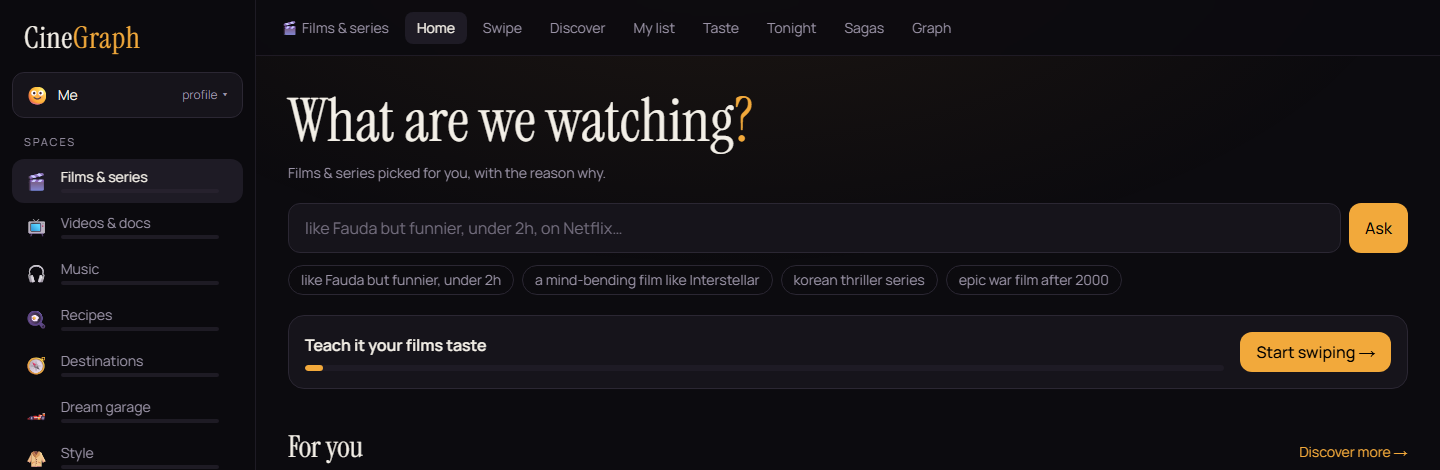
Why I built it
I wanted a taste engine that explains every recommendation and runs without a server, so that my memory stays on my own device. Films, series, music, recipes, travel, cars and style, all learned from a few swipes.
What it does
A personal taste engine that runs entirely in the browser. A weekly GitHub Actions job builds a knowledge graph, text embeddings and a collaborative-filtering model from TMDB, Wikidata and MovieLens; the app then ranks, learns online from each answer and keeps its memory on the device.
Worth a look
- Hybrid ranking: knowledge-graph paths, embeddings and implicit ALS, folded in on the device.
- Active learning picks the next card; a logistic ranker and a Thompson bandit adapt to each answer.
- Installable PWA with no server: static export on GitHub Pages, memory in IndexedDB.
Under the hood
Weekly data build
A GitHub Actions job pulls TMDB, Wikidata and MovieLens into Postgres with pgvector.
Three kinds of signal
A knowledge graph, text embeddings (fastembed bge-small) and a collaborative-filtering model (implicit ALS).
Static export
JSON and int8 matrices are published as a release asset and served by GitHub Pages: no backend at all.
Ranking in the browser
The PWA ranks with features, graph paths and a collaborative-filtering fold-in, all computed on the device.
Learning from each answer
Bayesian active learning picks the next card; a logistic ranker and a Thompson bandit adapt. Memory lives in IndexedDB.