Nuclear capital risk
Extend old nuclear reactors by 20 years or build new ones: which costs less, in money and in CO₂?
Why I built it
A large share of the world’s reactors are passing their 40-year design life. Is it better, in cost and in CO₂, to extend them by 20 years or to replace them? Group project for the Climate Risks course with Eliott Beghin, Saty Viard Laroque and Neel Sabarwhal, in the role of sustainability consultants to a utility board.
What it does
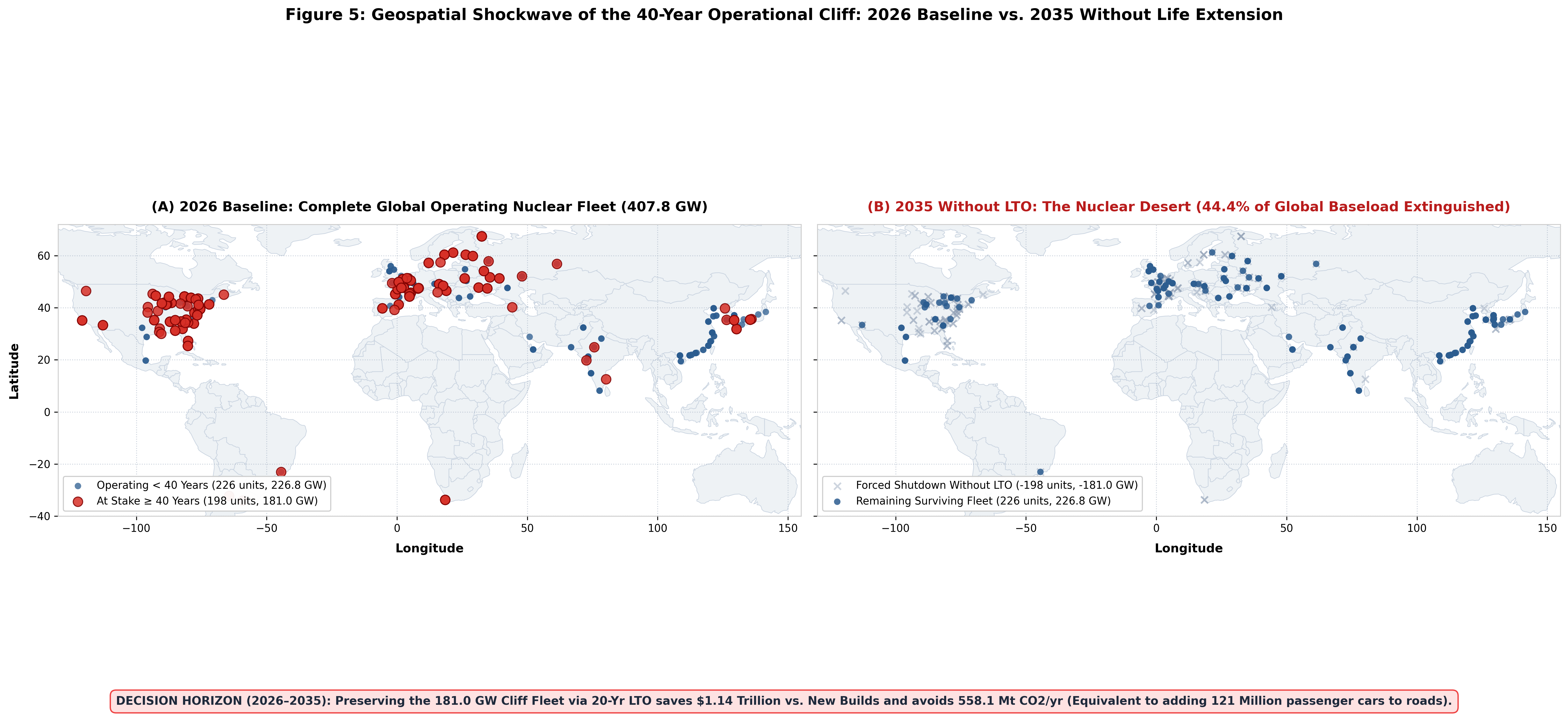
A cost-of-capital, LCOE and CO₂ model on the Global Energy Monitor tracker (1,825 units). 44% of operating capacity is already past 40 years; replacing it with gas would add about 558 Mt of CO₂ a year, and a 4-point rise in the cost of capital more than doubles the cost of a 10-year build.
Worth a look
- S-curve construction spending with compounding interest during construction.
- Sensitivity grids and three 20-year pathways: extend, new build, gas.
Under the hood
Clean the fleet
Parse dates from the Global Energy Monitor tracker (1,825 units), compute build times and ages, flag reactors past 40 years.
Financial model
Construction spending follows an S-curve (Beta 2.5, 2.5), interest during construction compounds mid-year, and LCOE uses a capital recovery factor.
Sensitivity
Grids cross the cost of capital with build time, so a 4-point rise in financing cost can be read directly.
Three pathways
Extend, build new, or replace with gas, over 20 years, with maps, age pyramid and heatmaps. Costs come from IEA/NEA, discount rates from Damodaran, emission factors from IPCC AR6.